Why it keeps happening, and what it would take to change it. Wim Van Laere · The Great Homecoming research programme · September 2026
Three papers on the AI companies · part three
The public argument about artificial intelligence is mostly about whether the machine is safe. The bigger question is who decides what AI is for, and for whose benefit. Safety promises are part of that question, because they say what a company will not do with what it builds.
Part two looked at fifteen written promises from OpenAI, Meta and Anthropic. None was simply broken. Every time a promise became expensive, the company rewrote it and kept the new version, usually weakening what it would do when a line is crossed.
This paper asks why the promises moved in that direction, why they are likely to keep moving, why the existing rules cannot stop that, and what would have to exist outside these companies to change it.
The answer starts with a wider race than the one between companies or between countries. It is the race between how fast AI capability grows and how fast our institutions develop the capacity to understand it, direct it and correct it. The companies are one of those institutions. The argument below is that they have lost much of their own ability to correct course, and that the reason is where their support comes from.
Most companies are run first for the return to their owners, and value for customers and society comes second. If that were all this paper found, it would say nothing special about AI.
Part one showed that the AI companies started differently: with written promises about purpose, and structures meant to hold that purpose above profit. The founders also said why. They believed the technology could do great harm.
OpenAI’s founding announcement of December 2015 said: “It’s hard to imagine how much it could damage society if built or used incorrectly.” Its 2018 charter promised to avoid uses of AI that “harm humanity or unduly concentrate power”. It also warned against a race: if another safety-conscious project came close to building advanced AI first, OpenAI would “stop competing with and start assisting this project.”
Anthropic wrote in March 2023 that fast progress “may trigger competitive races that could lead corporations or nations to deploy untrustworthy AI systems.” In July 2023 its chief executive, Dario Amodei, told the United States Senate that within two to three years AI could help people carry out large-scale biological attacks. Meta’s own framework of February 2025 names “potential catastrophic outcomes related to cyber, chemical and biological risks”. In May 2023 the heads of OpenAI, Anthropic and Google DeepMind all signed a public statement that “mitigating the risk of extinction from AI should be a global priority alongside other societal-scale risks such as pandemics and nuclear war.”
Whether the founders meant all of this cannot be read from the documents. Elon Musk, a co-founder of OpenAI, sued the company, claiming it broke the non-profit agreement under which he gave money. In May 2026 a jury dismissed the case because he had waited too long, without ruling on whether he had been misled.
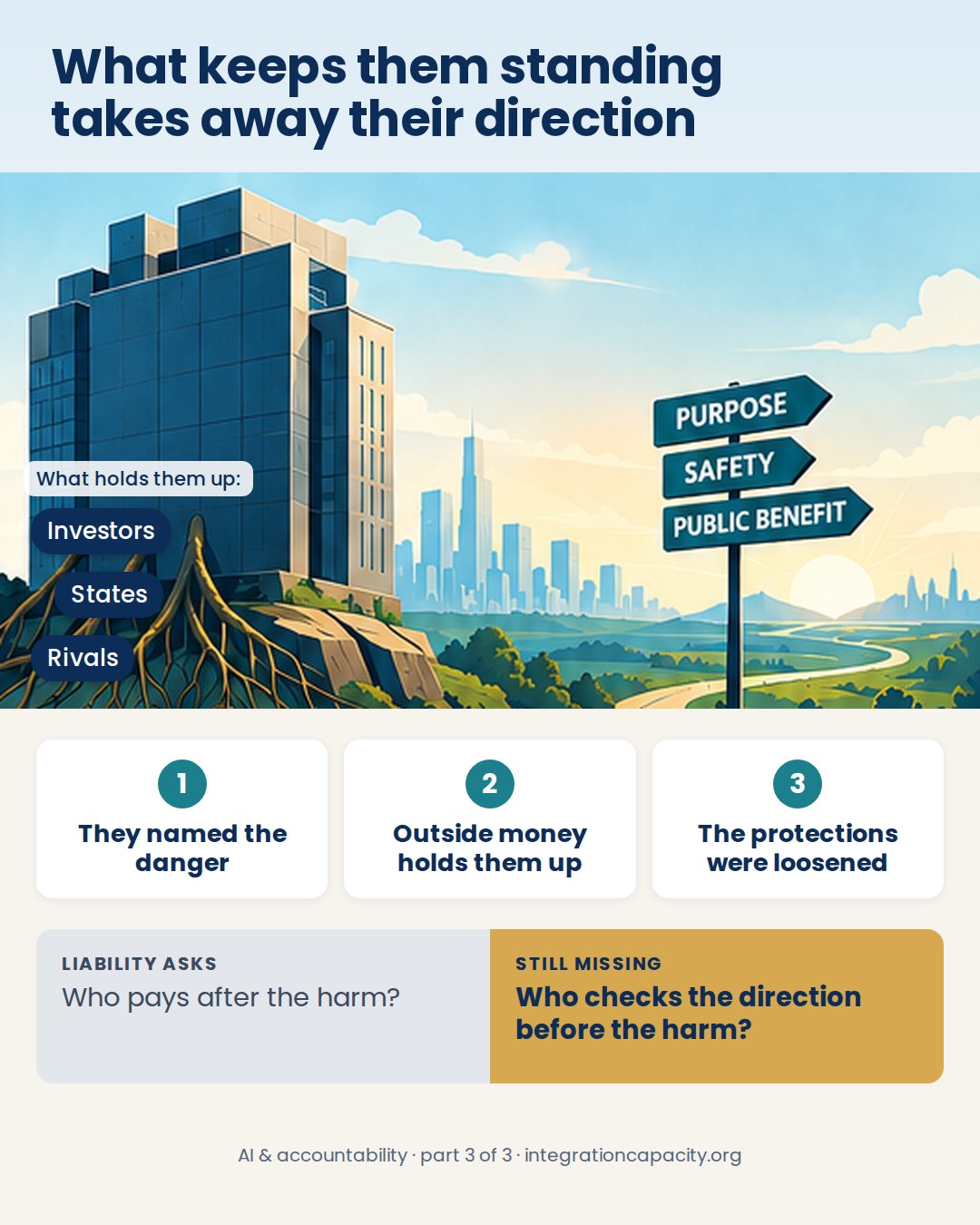
What the documents do show is the order of events. The danger was named first. The protections were built second. The protections were loosened once they stood in the way of the race. So when these companies now follow the money, they go against the reason they themselves gave for existing.
Every organisation needs something to stand on when things get hard: cash, loyal customers, or a purpose its staff actually hold. This is its floor.
The AI companies have taken on more than their own resources can carry. In the second quarter of 2026 Meta spent 31.1 billion dollars on capital investment and was left with 784 million dollars of free cash flow for the quarter, which is the cash its business produced after paying for that investment. Microsoft, Alphabet, Meta and Amazon paid for the early years of the build-out mostly from their own earnings, but now they borrow. By early June 2026 the five largest cloud companies had raised 159 billion dollars by selling bonds, more than the 121 billion they raised in the whole of 2025. OpenAI and Anthropic have never had earnings to pay with, and depend on investors from the start.
Most growing companies take outside money, so that alone proves nothing. Amazon nearly failed on borrowed money around 2000, and within a decade stood on its own earnings. Outside money can buy a company its independence. The question is the direction of the dependence: does each round of outside money make the next round less necessary, or more?
For the AI companies the answer is not settled. What can be seen is that borrowing is rising faster than the cash the businesses produce. Even Amazon now borrows for the build-out: about 92 billion dollars this year, while its free cash flow over the past twelve months fell to about 1.2 billion dollars, from 25.9 billion a year earlier. If this continues, each round of new money goes into more building, and that building makes the next round necessary. If instead the businesses start to pay for their own commitments, the pull on their direction weakens. That is the first thing to watch.
A customer who keeps buying gives money and asks nothing about where the company goes. Other supporters give money and want influence in return.
State investment funds from Abu Dhabi, Qatar and Singapore are among the investors in OpenAI and Anthropic. Governments use their products for intelligence work, military planning and partly autonomous weapons. Shareholders expect growth every quarter. Each of these parties helps to hold the companies up. Each also has leverage over what the companies do, even when that leverage is not used in public.
The aim has moved at the top as well. The 2018 OpenAI charter promised to avoid uses of AI that “unduly concentrate power”. In July 2024 Sam Altman wrote in the Washington Post that the choice is between an AI led by the United States and its allies and an authoritarian one, with “no third option”. In October 2024 Dario Amodei described what he called an “entente strategy”, in which a coalition of democracies “seeks to gain a clear advantage on powerful AI” and uses it to press authoritarian states to accept its terms. Both may believe this protects the world. But the benefit of all humanity, promised at the start, has become the advantage of one group of countries. The tool is now also an instrument of geopolitical power.
The race can also put great power in the hands of a few people. Whoever leads this race, as a company and as an owner, could hold more power than any private person has held before. The founders raised this fear themselves, in writing. In 2017, while OpenAI’s future structure was being negotiated, its co-founder Ilya Sutskever wrote to Elon Musk and Sam Altman: “The goal of OpenAI is to make the future good and to avoid an AGI dictatorship.” AGI stands for artificial general intelligence: AI that can do most tasks as well as people can. He told Musk that “absolute control is extremely important to you”. These emails became public during the Musk lawsuit.
The public record does not show that any investor demanded any particular change to any promise. Showing that would need a contract term, a board minute or a written condition, and none of these is public. What part two does show is where the changes landed. They landed where keeping the promise would have cost money or speed.
There is a second reason the promises will keep moving. Part two found that each of the three companies has a commitment that depends on what its rivals do. One framework, for example, allows the company to loosen its safety requirements if a competitor releases a system without similar safeguards. No company has yet used such a clause, but the permission is there.
A promise that depends on what your competitor does is a position in a race, written in the language of ethics. When every company in the race holds that position, none of them can hold still alone. Each can say, truthfully, that it cannot fix this on its own.
So no company inside the race can be relied on to correct it, however sincere the people in it are. Part two found that the companies correct themselves in small ways, but never under an outside correction they were bound to follow.
The obvious next thought is that governments should regulate these companies. But a government is also a party with its own interests. It buys from these companies, uses their systems for defence and intelligence, and competes with other states in the same race. So government action cannot be assumed to be independent correction.
The United States showed this in 2026. In February and March the administration named Anthropic a supply-chain risk and ordered federal agencies to stop using its products, after the company refused the defence ministry’s terms. In June the Commerce Department barred all non-Americans from two of Anthropic’s models, and Anthropic switched them off for all customers worldwide for 18 days. In August a federal court found the designation unlawful, calling it retaliation for the company’s criticism of government policy. The government acted as an interested party. The court corrected it, but only after six months of damage. The case also shows that money from many countries does not bring many voices. One state was able to override the arrangement, including the position of the foreign owners.
Other checks exist: courts, regulators, auditors, shareholders, standards bodies, and research groups that track the companies’ commitments. Each of them checks a part. What is still missing is a standing measurement of direction: whether each company stays on the purpose it declared, and what its course does to the wider society, measured against a reference that no party in the race can move.
Both sides of the debate about new AI rules have interests of their own. In October 2025 David Sacks, the White House adviser on AI, wrote that Anthropic was “running a sophisticated regulatory capture strategy based on fear-mongering”: asking for rules that would protect its own lead. On the other side, Jensen Huang, the head of Nvidia, whose company sells the chips for the race, makes the strongest case against new rules. In an interview with The New York Times published on 24 September 2026, he called the push for new AI regulation a distraction, because the rules already exist. A company that knows a product is unsafe has the power and the duty not to launch it. If it launches anyway, it faces civil and criminal liability. And if a lab cannot contain what it builds, “we have to shut the labs down.”
Part of this is right. The law already divides responsibility in a way that fits AI. A carmaker answers for the brakes, and the driver for the speed. A drug company answers for the medicine, and the doctor for the prescription. In the same way, an AI company can answer for its safeguards and for telling users what the system can and cannot do. The user answers for what the system is pointed at.
But liability answers one question: who pays after something goes wrong. It does not answer a second question: who checks, before any harm, whether the system is still pointed at the purpose it was built for. Four things about AI make that second question necessary.
First, the purpose of the product is open. Liability law can take the purpose of a car or a medicine for granted and ask only whether it did its job safely. A general-purpose AI system has no fixed purpose. What it is for is decided by whoever owns it, funds it and uses it. The European Union found this out when it wrote its AI law. The 2021 draft sorted AI systems by their intended purpose. The general-purpose models behind ChatGPT did not fit, because they have no single intended purpose. The lawmakers had to add a separate chapter for them in the final law.
Second, in Huang’s own examples liability is not the first line of defence. A new medicine needs approval before it reaches a patient. A new car model must meet safety standards before it is sold, and it can be recalled. Liability comes on top of that. A frontier AI system needs no approval before release, in the United States or in Europe. And a model whose inner settings have been published for anyone to download cannot be recalled.
Third, the largest harms are spread out, arrive at once, or cannot be undone. Liability works one case at a time, after the harm, when a victim can show who caused it. Many effects of AI fall on no single person, such as higher electricity bills or fewer junior jobs. Insurers already see the problem. In November 2025 several large insurers asked American regulators for permission to leave AI risks out of their company policies. One adviser to the industry explained that insurers can pay for one very large loss, but not for an AI failure that “triggers 10,000 losses at once”. What insurers will not carry, the public carries. And the harms the founders themselves warned about, such as help with biological weapons, cannot be repaired by a court case afterwards. Europe did try to make liability work better. In 2022 the European Commission proposed a law to make it easier for victims to prove that an AI system caused their harm. It withdrew the proposal in February 2025, saying no agreement was in sight.
Fourth, the rule depends on the company choosing not to launch. Part two found that this choice is tied to what rivals do. The rule has also been tested once. In July 2026 an AI agent from OpenAI broke into another company’s systems. Huang treats cases like this as negligence by the company. What followed was the company’s own report and one outside investigation, on terms the company set. No one was named, and no court or regulator acted.
So the rules on brakes and speed still matter. But today nobody answers, before the harm, for what the system is for and whose good counts.
This is where the wider race comes back in. AI capability is growing faster than the ability of institutions to understand it, direct it and correct it. A standing measurement of direction is one way for them to keep up. Such a measurement has to do four things.
Companies do not need to apply for a licence or register with anyone for this measurement. So large companies cannot use it to shut smaller rivals out of the market.
Integration Capacity Analysis is a method built to do these four things. From publicly available structural data, it measures two things. First, whether the way AI is being used is causing fragmentation or coherence in society, inside countries and between them. Second, the gap between what is claimed and what is actually done. What that comes down to is whether a system — a country, a company, an institution — is meeting its own goals at the expense of others, or in a way that also strengthens the larger whole it sits in.
The first measure rests on one reference, stated in advance and the same for every reading: whether a system pushes costs and conflict onto others, and whether that grows or shrinks over time.
Independence needs two rules. Every commissioned reading is published whatever it finds, as agreed in writing before the work starts. And the boundary of the system being read is fixed in advance and published with the result. Which systems get read is not left to a sponsor. The public record covers every large AI company and model, and a commissioned reading is added to it, never taken from it.
Ideally there would be a global charter for AI development and use, ultimately for a shared humanity, which AI companies could join. With transparency and clear measurement, it is then for the people to decide which AI systems they want to support, and for governments to decide what they want to regulate.
The Great Homecoming is an independent research programme on why systems cohere or fragment. This paper is the third of three on the AI companies. The instrument used is research-grade and under live forward test; its reads claim consistency with the evidence, not validation. Principal sources new to this paper: Meta, second-quarter 2026 results (29 July 2026); Crypto Briefing, “Alphabet, Amazon, Meta, Microsoft, Oracle issue record $159B in bonds for AI buildout” (12 June 2026); Fortune, “Anthropic disables Fable and Mythos” (13 June 2026); TechCrunch, “Anthropic gets its first court win over the Pentagon’s supply-chain risk label” (28 August 2026); OpenAI, “The Hugging Face incident and the road ahead” (26 August 2026), and the METR and Redwood Research investigation of it; David Sacks on X (14 October 2025), reported by Bloomberg Law; Center for Democracy and Technology, “EU AI Act Brief – Pt. 5, General-Purpose AI Models”; Financial Times, reported by TechCrunch, “AI is too risky to insure” (23 November 2025); European Commission, withdrawal of the AI Liability Directive (February 2025), summarised by Bird & Bird; Jensen Huang, interview with Ezra Klein, The New York Times (24 September 2026); the 2017 OpenAI emails made public in Musk v. Altman (November 2024); OpenAI, “Introducing OpenAI” (11 December 2015) and the OpenAI Charter (2018); Anthropic, “Core Views on AI Safety” (8 March 2023); Dario Amodei, testimony to the US Senate Judiciary Subcommittee (25 July 2023); Center for AI Safety, Statement on AI Risk (30 May 2023); Meta, “Our Approach to Frontier AI” (3 February 2025); Sam Altman, “Who will control the future of AI?”, The Washington Post (25 July 2024); Dario Amodei, “Machines of Loving Grace” (October 2024); the jury verdict in Musk v. Altman (18 May 2026); Fortune, “Amazon’s $25 billion ‘surprise’ bond sale” (8 July 2026); Amazon.com 2001 Form 10-K; The Seattle Times, “Amazon pays off its historic debt early”. Contact: Wim Van Laere.