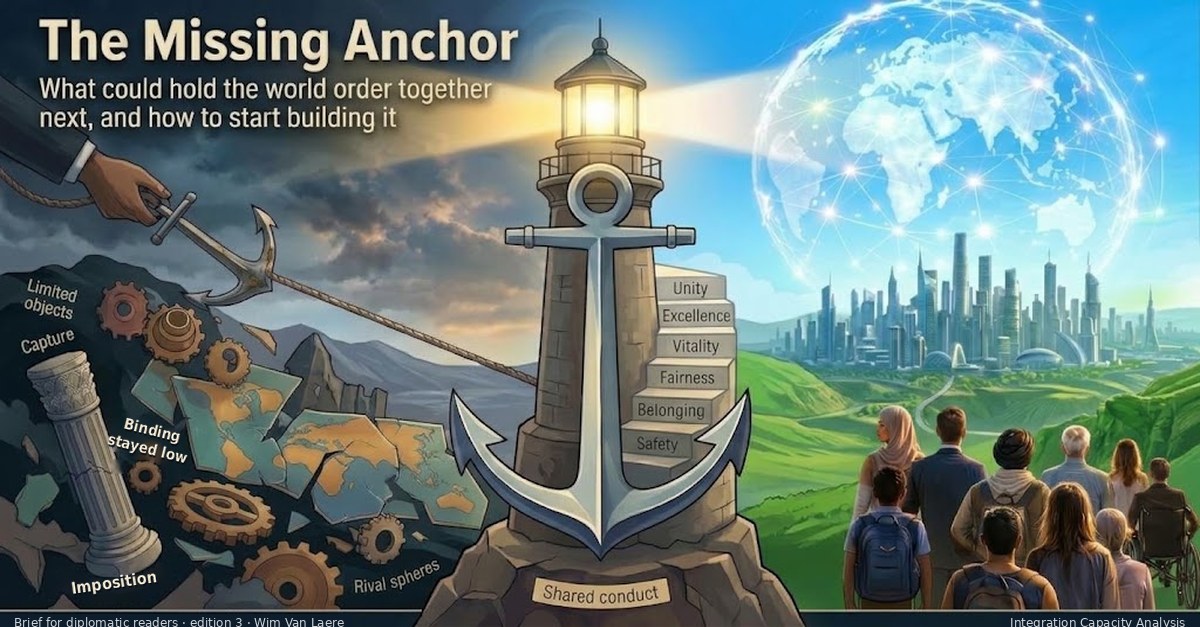
What could hold the world order together next, and how to start building it. Wim Van Laere · Integration Capacity Analysis · October 2026 · brief for diplomatic readers, edition 3
Status. This brief draws on a longer working paper of the same name, which is available on request. The current arrangements discussed below were read by one reader, the author, from dated public records up to 28 September 2026. Facts re-checked on 19 October 2026. The reading was not blind and has not yet been repeated by others. The method behind it is under test; none of its claims is validated.
An order holds when the states and peoples inside it hold on to something shared, even when that costs them. We call that shared reference an anchor. An anchor needs two things. It must be named, so people know what they hold on to. And it must be paid for, so the holding is real.
For a century the world has tried to give itself an anchor: the League of Nations, the United Nations, the Bretton Woods institutions, the Universal Declaration of Human Rights, and the liberal order after 1989. Each held partly and for a time. None held as a whole. In the reading made for this brief, four reasons recur:
New binding is also forming. About twenty current arrangements were read with two questions. Do members pay a real cost to keep the shared thing alive, even when it hurts? And does the arrangement name a purpose beyond itself? The result is a split. Where members pay, the arrangement names no purpose: the WTO’s interim appeal arrangement binds 61 members (March 2026) to rulings they may lose, and calls itself “interim”. Where an initiative names a large purpose, members pay no real cost. Two partial exceptions stand out. The African Union suspends governments that take power by coup. The Islamic Development Bank’s 57 members pay real capital under a named purpose of solidarity, though for one tradition only.
For most of modern history the strongest states could expect the world one day to be organised around their own model. That expectation now meets a structural limit. No great power can turn its own model into a universal order without provoking the others and paying a rising cost. A lasting order must therefore do something earlier orders did not: allow the great powers to remain great powers without requiring the rest of the world to become like them.
Three futures remain:
The case for the third rests on one observation: there is no outside left. Large systems have almost always grown partly by pushing costs outward: onto nature, onto other peoples, or onto the future through debt. At world scale that path is closing. Imposition and rival spheres both depend on it. A global order has to carry its costs inside itself, and that requires binding that holds when it costs something.
The same reading applies to conflict and its aftermath. A war economy binds hard against an enemy and pushes its costs outward. Reconstruction after war is not only the rebuilding of roads and power lines. It is the slower rebuilding of bonds across the lines that broke: trade, shared institutions, courts that bind the stronger party. The working hypothesis behind this brief is that the thinning of such bonds shows in conduct before it shows in opinion surveys, early enough to act. This is a hypothesis under test, not a finding.
Five requirements follow. They are necessary conditions, not a complete design.
The open reference. There are two ways to get the last point wrong. One is a limited power dressed as the highest: a state, a bloc or one religious authority speaking for what is highest. The other is a neutrality that forbids any higher reference. The design that avoids both is an open reference. Each tradition names what is highest in its own language, whether God, Heaven, the Tao, Dharma, the moral law or human dignity, and gives its own reasons for a shared core the traditions already hold: treat others as you would be treated; protect life; keep promises; deal fairly; care for the weak; tell the truth. The philosopher Charles Taylor called this an “unforced consensus”. The covenant judges conduct, never doctrine.
No single authority. A global covenant has no single authority to settle disputes, and should not have one. That role has to be spread over many hands: rulings that members accept in advance, regional courts, an independent reading of conduct by more than one reader, and respected voices who advise without holding power. Whether these together can do what a single authority does is the least tested part of the proposal.
The ladder, and four ways of holding it. The model reads binding on six levels. Each rests on the one below: safety, the basic security to survive and plan ahead; belonging, where each party counts as an equal member, and none stands above the others or acts as if it can do without them; fairness, where the rules bind the strong as well as the weak; vitality, where each party can develop and flourish on its own strength, not on support borrowed from others; excellence, where each party acts as a responsible member that strengthens the community and does more for it than it is obliged to; and unity, where the members, each staying sovereign, act as one for the greater good, not only of themselves but of the wider community, including those outside the membership. Trust is the result of belonging: it grows each time belonging holds under pressure, for example when a promise is kept even though keeping it costs.
Parties can hold each level in four ways. As an aspiration: the level is named as a direction, in a charter or a speech, but not yet acted on. As an intention: first steps show that it is meant, but it has not been tested. As a commitment: it is pledged, specific and checkable, and it has held when keeping it cost something. As a structure: it has become a rule, a treaty or an institution that carries it. A structure stays alive only while the aspiration behind it stays alive; without that aspiration, the structure becomes an empty shell.
Today, states commit to each other mostly at the first two levels: safety, and belonging, where trust is built. It rarely reaches fairness. The language of the global order speaks at the highest levels, as aspiration. The work of the covenant is to move each level, step by step, from aspiration to structure. Where each level stands is different for every bond, and it moves.
The covenant is not built by a plan carried out from the top. It is built by a repeated cycle, run at every scale, from two neighbouring states to a region to the global floor. The parties treat each other as actors who can learn and change, not as fixed positions to be won or lost.
Step 1. Each party states its charter. Before anyone binds, each party writes down, in a short public text, what it stands for and what it rejects; what it aspires to, including where its own conduct falls short of its words; where it really stands today; and how it deals with others, including how it handles difference and repairs harm. A national security strategy or a constitution can be the starting point. But a charter is more than a list of interests and red lines: it carries a vision. That is why work on direction starts on the first day. For each level, the charter also says what the party means by it, whether it holds it as an aspiration, an intention or a commitment, and what it is willing to pay. Where two parties mean different things by the same word, such as fairness, the reading looks for the widest overlap they can see and the smallest step on it they are willing to take now. That overlap is then widened step by step, on every level, and read again at every cycle, because even agreed words can still be understood differently.
Step 2. Read the bonds, not only the parties. For each bond between two parties, five kinds of question. Content: what runs through it (shared meaning, exchange, or money, goods and people), and how thick it is. Form: does it run one way, both ways, or has it formed a shared body? Effect: does the weaker side advance, or does one side keep draining the other; and what has the bond left behind, such as a treaty kept or a habit of calling each other in a crisis? Reference: what shared thing holds the bond together? Holding: at which levels is the bond only an aspiration or an intention, and where is it a commitment or a structure? Alongside the bonds, one reads what pulls the parties apart.
Step 3. Bridge with the tool that fits. Build on what both sides already hold. Make a bond thicker: share more, do more together, find more in common. Change the shape of a flow: let a one-way flow that keeps one side dependent narrow over time; open an exchange that only a small circle enjoys; let an exchange that has proved itself grow into a shared body. Add what is missing: give a bond of pure trade a shared purpose, and give a bond of shared words a real exchange or cost. Move a level one step: turn an aspiration into a stated intention, or an intention into a commitment with a cost. Park what cannot be settled now, so that it does not block the rest. Acknowledge old harm where it blocks trust.
Step 4. Read again, and adjust. Three roles carry the cycle: an alignment holder who keeps the shared direction in view; a working team that turns each agreement into steps that can be measured; and a facilitator, owned by no party, who runs two reviews a year: one on what was agreed and kept, and one on how the parties work together. Both record which levels moved from aspiration towards structure.
Three rules run through the cycle:
The great powers join when they are ready to accept rulings they may lose. The start does not need to wait for them.
Every year, read from what members do, by more than one independent reader, and never by the body being measured:
It claims that the four failures of past anchors are general, not accidental; that the split between what binds and what names a purpose can be observed today; that no great power can now make its own model the world’s anchor; and that if a lasting order forms at today’s level of complexity, it will have to be a covenant that no party owns. It does not claim that the covenant will happen, or that it will succeed.
The argument would be shown wrong if one power made its model the world’s anchor without rising coercion; if rival spheres proved stable while carrying their own costs; if the split between binding and purpose closed on its own; or if an open reference proved impossible to keep from capture.
The tool that reads bonds between parties in the way step 2 describes is being developed. It has been tried on a handful of bonds inside one country, not yet between nations. Nothing in this brief has yet been tested in diplomacy. The author is European; post-colonial history and non-Western cases were included to correct for that. The author has links to the Baku Process; the same tests were applied to it as to the others.
Complete sources are in the full working paper, available on request.
Working paper, for discussion. The full working paper is available on request: wim@integrationcapacity.org