Why globalists and nationalists fail the same test — and what has to be rebuilt. The Great Homecoming research programme · September 2026
The world has never been more connected, and never less bound.
The argument now consuming us has two sides. One says the answer is the nation: peoples and cultures are real, and only they command the loyalty that lets a society act. The other says the problems cross every border — a pandemic, the climate, the money system — so the answer has to cross borders too. This month in Project Syndicate, Gordon Brown made the honest globalist case: the world's institutions are “hollowing out,” yet most people still want countries to work together, so the job is to save cooperation. The nationalist says the opposite: pull the world back to a size one nation can hold. Both are half right, and both fail on the same point.
We have lost a simple distinction. Connection is what a system does in calm weather: trade, summits, treaties, money and data moving across borders. Binding is what it does in a storm — whether the parts will pay a price to hold the whole together when it hurts them. The pandemic showed the difference in a week. The machinery of cooperation was all still there, and the moment it cost something, states hoarded supplies and closed their borders. There was plenty of connection. There was nothing binding underneath it.
By a shared good I mean something whose worth does not shrink when it is shared — safety, trust, a common purpose people will carry at a cost to themselves. It is the opposite of a finite good, which we can only divide and compete over. Binding needs a shared good; connection does not. So the order is not short of cooperation. It has never had more. What it lacks is a shared good to hold the cooperation together.
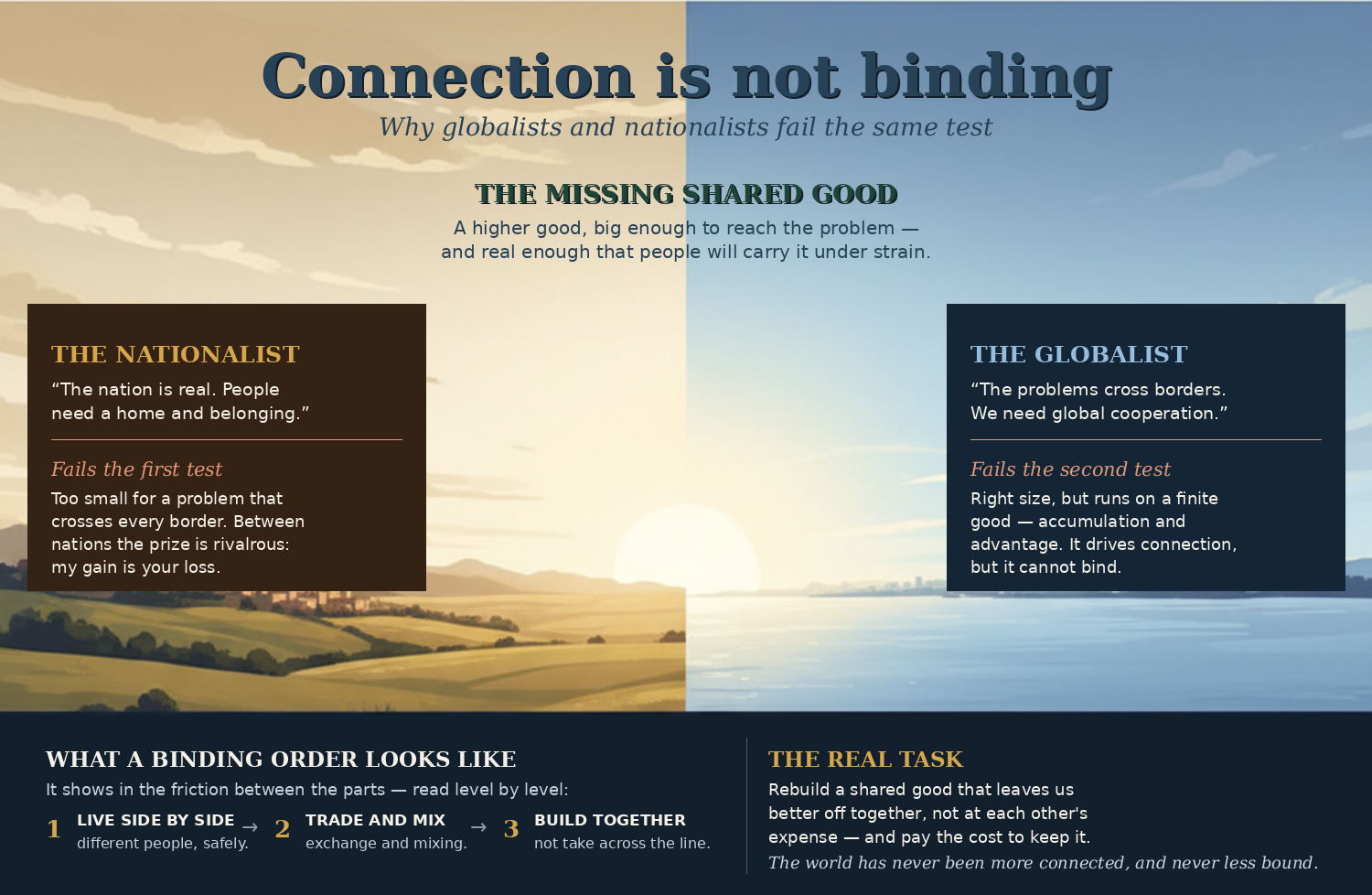
Any order that governs a shared problem has to pass two tests, and they are separate. It has to be big enough to reach the problem. And it has to rest on a good that is genuinely shared. Neither camp is a single thing — the globalist may be a liberal institutionalist, a cosmopolitan or a technocrat; the nationalist may want civic pride, protection, or sovereignty first — but on these two tests they divide the same way.
The nationalist fails the first test. A nation is too small for a problem that crosses every border, and between nations the prize is rivalrous: my gain is your loss. But the nationalist instinct is not only wrong. The wish to make things simple again, to pull the world back to something a person can see and belong to, is an honest admission that the global system can no longer manage the complexity it built. That admission is worth hearing, even when the cure fails.
The globalist fails the second test, and it is the harder failure to see, because it speaks the language of the shared good — humanity, the common home. It has the right size. But it keeps the machinery of a shared order running on a good that is no longer shared. In our own reading of the global order, the thing the world's systems now organise around is no longer an open, rules-based project but a finite one: accumulation and advantage. A rivalrous good — one we compete over — can drive enormous connection. What it cannot do, on its own, is give enough of us a reason to sacrifice for the whole. And without that reason, nothing binds.
Put the two next to each other and it is the same mistake at two sizes: a finite good sitting where a shared one should be. The nation is finite and honest about it; it says it is about us. Today's globalism is finite in disguise; it organises around advantage while speaking for everyone. Saving its institutions, as Brown urges, will not repair that. More institutions only add more connection, and connection was never what failed.
So the real task is the one neither camp will name. We have to build a global anchor again: a highest shared good that leaves us better off together instead of at each other's expense, and that we are willing to give up some comfort to keep. Not a world government, and not a retreat into the nation, but a good big enough to reach the problem and real enough that people will carry it under strain. Nothing smaller will hold a problem this size.
This is not only a claim to argue over. The difference between an order that binds and one that only connects shows up in the friction between its parts, and friction can be read. We read it group by group and level by level: whether people on different sides can simply live side by side, whether they trade and mix, and whether their institutions still build things together or only take across the line. That reading is the work of our research programme now. It is not a finished instrument, and we do not present it as one. But it turns a shouting match into a sequence you can follow and check: connection, then binding, then the shared good, then the friction that shows whether the good is really there.
The nationalist and the globalist are both answers to a real fear. Neither is the answer. The answer is to rebuild the shared good both camps have lost, and then to pay what it costs to keep it.
The Great Homecoming is an independent research programme on why systems cohere or fragment. It works through Integration Capacity Analysis, an instrument that reads whether the parts of a system are still building together or coming apart. Companion reading: “The World That Outran Its Anchor.” The instrument described is under live forward test; we describe it that way until its register adjudicates. Contact: Wim Van Laere.